Tech
Parametric Fashion
92 million tons of textile waste per year. 30% of garments never sold. $816B in returns — 70% from poor fit. What if every garment was made for the person who ordered it? Parametric fashion replaces standard sizing with mathematics. Every dimension is a function of the wearer's body. No sizes. No inventory. No waste. The technology stack is 90% built. 3D body scanning, garment simulation, and whole-garment knitting machines are all production-ready. What's missing is the AI/ML bridge — software that converts a body scan into fabrication instructions for a specific parametric design. That bridge is what we're building.
Interactive Prototype
The Body Is the Blueprint
Drag the sliders to change body measurements. The silhouette morphs, the garment reshapes, and the pattern pieces recalculate in real time.
BODY → GARMENT
C=96 → c=52.0
W=80 → w=43.0
S=44 → s=46.0
A=65 → a=61.8
T=55 → t=53.0
Measurements
Traditional Cut Pattern — Fabric Utilization
Parametric whole-garment knitting eliminates cutting waste entirely.
The Core Loop
- Scan — capture your body with a phone camera (96-97% accuracy vs. manual measurement)
- Design — choose a garment from the parametric marketplace
- Simulate — preview it on your avatar, fine-tune fit with presets and sliders
- Compile — the platform maps your measurements against the designer's parametric template
- Fabricate — machine-ready instructions dispatched to a micro-fabrication center
- Ship — a finished, custom-fit garment delivered to your door
- Improve — fit ratings feed back into ML models; each garment makes the next one better
Every order feeds a closed-loop system: consumers rate fit per body region, the platform clusters feedback by body type, and the underlying ML models recalibrate. Each garment produced makes the next one fit better.
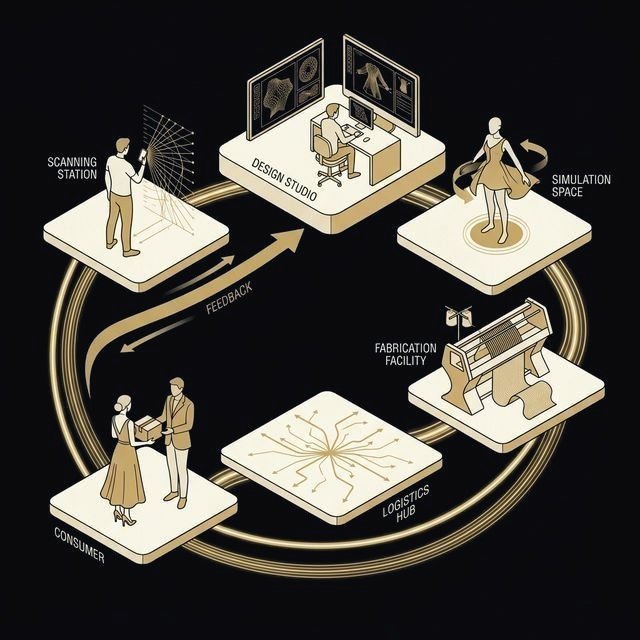
scan → design → simulate → compile → fabricate → ship → improve
Why Knitwear First
Whole-garment knitting machines already exist. Shima Seiki and Stoll build industrial flat-bed knitters that produce complete, seamless garments in a single operation — no cutting, no sewing, no post-production. A single machine takes yarn in and produces a finished sweater. Zero seams. Zero waste.
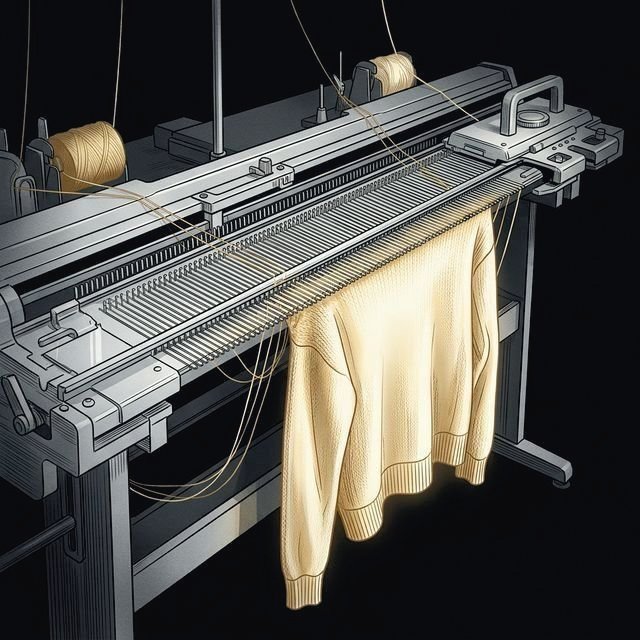
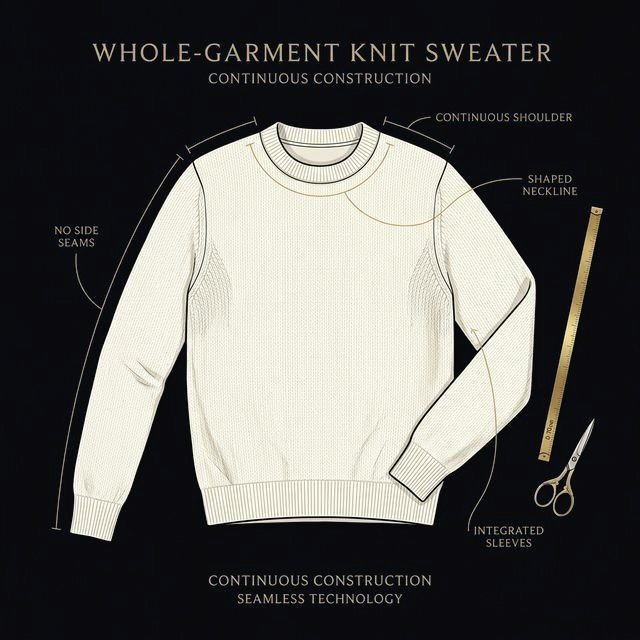
Left: a whole-garment machine takes yarn in and produces a finished sweater. Right: seamless construction — no cutting, no sewing, no waste.
Working Platform
The Ecosystem in Action
A modular monolith serving three audiences — consumers, designers, and operators — through a single unified platform.
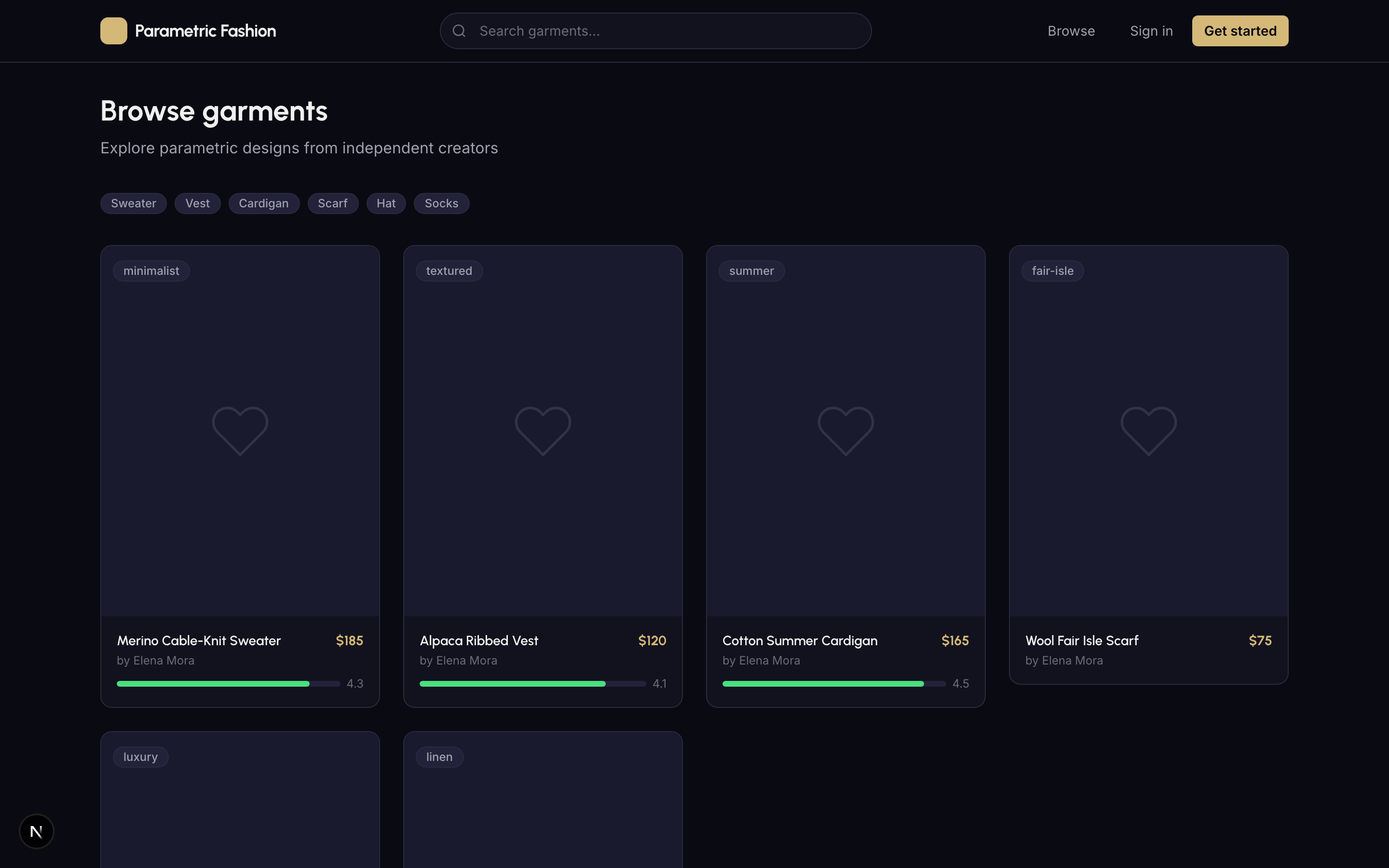
Consumers browse parametric garments with real-time fit scoring and category filtering.
The Build
KnitForge is the production-grade geometry-to-fabrication pipeline: 31,000 lines of Python, 1,088 tests, compiling 3D body geometry into machine-readable knitting instructions. The consumer platform is a FastAPI modular monolith (8 domain modules) serving a Next.js 15 frontend with Three.js avatar rendering and real-time pattern generation via KnitForge's REST API.
The market is $63.8 billion in 2025, projected to reach $179.5 billion by 2033 at 10.9% CAGR. The trigger: CLO and Shima Seiki announced a direct integration partnership in March 2026, validating the exact pipeline this platform builds.
Looking For
Machine Access
Industrial whole-garment knitting machines (Shima Seiki, Stoll) for prototyping and production validation.
Fashion Collaborators
Designers and brands interested in parametric garment templates, custom-fit collections, or zero-waste manufacturing.
Investment
Seed funding to scale the platform — from body scanning pipeline to consumer marketplace launch.
Interested in this work?
Inquire